


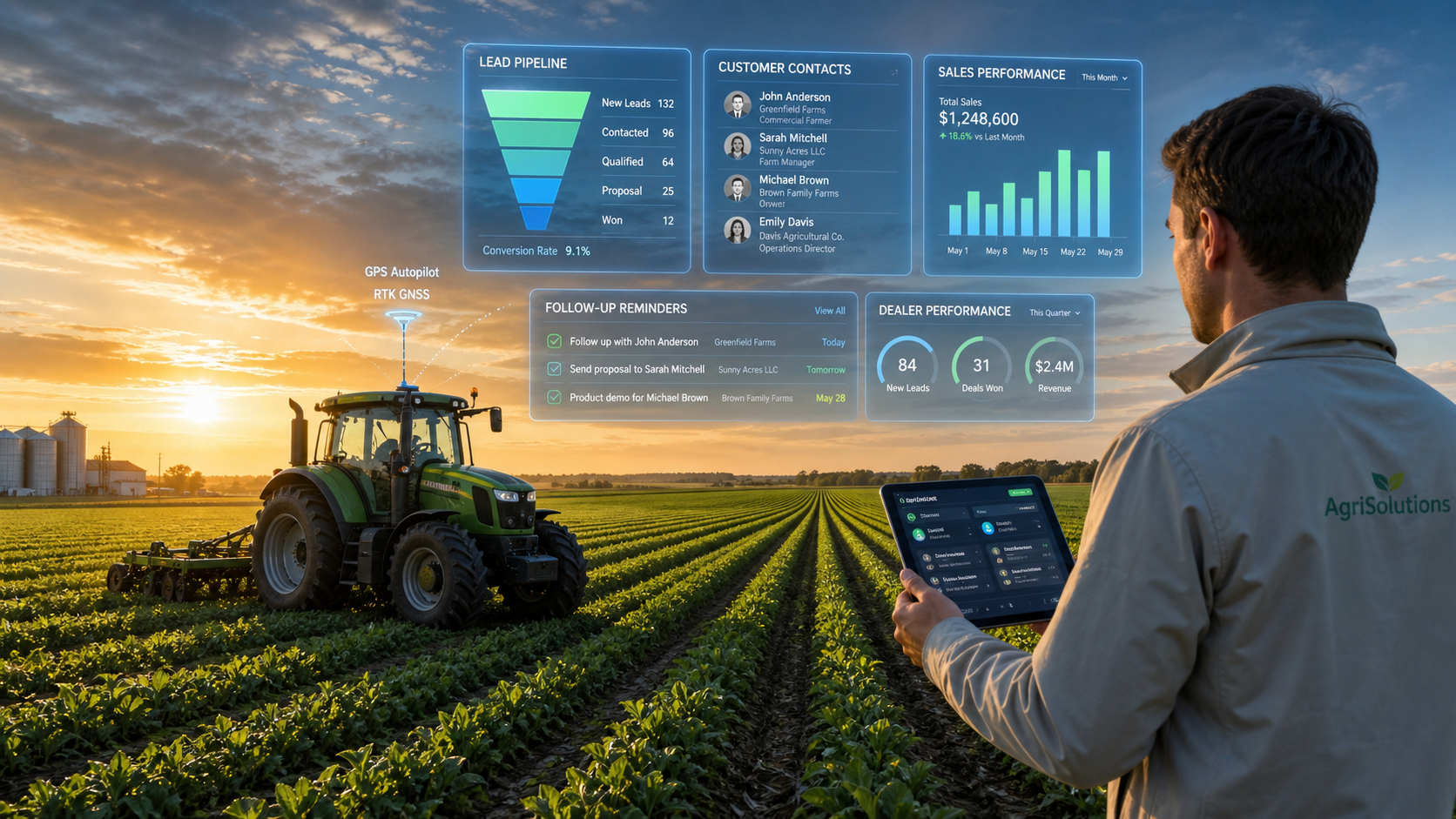
The precision agriculture industry is growing fast. GPS-guided autopilot systems, RTK GNSS survey equipment, and smart farming navigation tools are becoming standard on farms across the world. For dealers and distributors selling this kind of equipment, the opportunity is bigger than ever — but so is the competition.
Most precision agriculture equipment dealers focus heavily on the technical side of their products. They invest in training, product demonstrations, and after-sales support. But many of the same dealers lose potential clients not because of poor products, but because of poor follow-up, disorganized lead tracking, and inconsistent communication. This is exactly where CRM software becomes a game changer.
What Is CRM and Why Does It Matter for Agri-Tech Dealers
CRM stands for Customer Relationship Management. It is a software platform that helps businesses track every interaction with current and potential customers — from the first inquiry to the final sale and beyond.
For precision agriculture equipment dealers, this means having a single system where you can log farmer inquiries, track which products they are interested in, record quote histories, set follow-up reminders, and monitor the full sales journey from start to close.
Without a CRM, most dealers rely on spreadsheets, WhatsApp messages, or memory to manage their leads. That works for a handful of clients, but when you are managing dozens of active inquiries across multiple regions or product lines — autopilot systems, RTK base stations, GNSS handheld devices — things fall through the cracks quickly.
The Unique Sales Challenges of Precision Agriculture Equipment
Selling precision agriculture equipment is not like selling consumable farm supplies. These are high-value, technical products with long sales cycles. A farmer or agri-business considering a GPS autopilot system or GNSS survey kit may take weeks or even months to make a final decision. During that time, they ask questions, request demos, compare models, and consult with other stakeholders.
Here are the key sales challenges agri-tech dealers face that a CRM directly solves:
- Long decision timelines — Farmers evaluate equipment carefully before committing to a high-ticket purchase, requiring consistent nurturing over time
- Multiple decision-makers — In larger farm operations, the purchasing decision may involve the farm owner, operations manager, and a technical advisor
- After-sales service tracking — Precision equipment requires installation support, firmware updates, and ongoing technical assistance that must be tracked per client
- Dealer network management — Many GNSS and autopilot equipment distributors manage a network of regional sub-dealers, each with their own clients and pipelines
- Seasonal demand cycles — Agri-tech sales often spike before planting seasons, requiring dealers to prioritize and move quickly on warm leads
Each of these challenges has a direct solution inside a well-configured CRM system.
How CRM Transforms Lead Management for Equipment Dealers
When a farmer or agri-business contacts a precision agriculture dealer — whether through a website form, trade show, or referral — that inquiry needs to be captured, assigned, and followed up on immediately. A CRM makes this process automatic and organized.
Here is how a typical sales workflow looks inside a CRM for an agri-tech dealer:
- Lead capture — Inquiry comes in from website, phone, or email and is logged automatically or manually in the CRM
- Lead assignment — The inquiry is assigned to the relevant sales rep or regional dealer based on location or product interest
- Qualification — The sales rep records key details: farm size, crop type, GPS equipment currently in use, budget range, and timeline
- Quote tracking — Pricing proposals are attached to the contact record so the team always knows what was offered and when
- Follow-up scheduling — Automated reminders ensure no lead goes cold; the system prompts the rep to check in at the right time
- Deal close — When the farmer commits, the CRM updates the pipeline and triggers the after-sales support workflow
- Post-sale relationship — Service visits, firmware updates, warranty reminders, and renewal opportunities are all logged under the same client profile
This structured workflow means every lead gets the same quality of attention — regardless of how many inquiries the team is managing simultaneously.
CRM for After-Sales Support in Precision Agriculture
One of the most overlooked benefits of CRM in the agri-tech space is after-sales support management. Precision agriculture equipment like RTK GNSS systems and autopilot navigation devices require installation, calibration, technical training, and ongoing maintenance. These touchpoints are also opportunities to build loyalty and generate referrals.
With a CRM, dealers can log every service interaction per client. If a farmer calls with a calibration issue on their autopilot system six months after purchase, the support team can instantly pull up the full account history — product model, installation date, previous service notes, and contact preferences. This level of preparedness builds trust and significantly improves the customer experience.
Strong after-sales support tracked through CRM also increases the chance of upselling. A dealer who knows a client purchased a basic GNSS handheld two years ago can proactively reach out when an upgraded RTK base station model launches — turning a past customer into a repeat buyer.
Managing a Dealer Network With CRM
For precision agriculture brands that operate through regional distributors and sub-dealers, CRM adds another layer of value at the network management level. Instead of relying on manual reports or sporadic check-ins, a CRM gives the parent company full visibility into how each dealer is performing.
Key metrics that become trackable across the dealer network include:
- Number of active leads per dealer
- Average deal close time by region
- Most popular product inquiries by geography
- Response time from first contact to first follow-up
- Revenue pipeline per dealer per quarter
This data helps leadership identify which dealers need support, which regions have untapped demand, and where training or resources should be directed. It transforms dealer management from a reactive process into a proactive growth strategy.
Choosing the Right CRM for Your Agri-Tech Business
Not every CRM is built the same way. Some platforms are designed for large enterprise teams with complex workflows, while others are lean and practical — well-suited for small to mid-sized agri-tech dealerships managing a focused product line.
When evaluating CRM options for your precision agriculture business, look for these core features:
- Pipeline visualization — A clear view of where every lead sits in the sales process
- Contact and account management — Ability to store detailed client profiles including farm details and equipment history
- Task and reminder system — Automated follow-up prompts so no lead is forgotten
- Mobile access — Sales reps working in the field need CRM access from their phones
- Reporting and analytics — Simple dashboards showing conversion rates, lead sources, and revenue forecasts
- Integration capability — Ability to connect with email, WhatsApp, or other communication tools the team already uses
For dealers researching the right platform, resources like TheGreatCRM provide helpful comparisons, reviews, and guides to help agri-tech businesses find a CRM that fits their specific workflow and budget.
Real Results Dealers Can Expect From CRM Adoption
Dealers who implement CRM consistently report measurable improvements in their sales performance. The most common outcomes include faster response times to new inquiries, higher lead-to-sale conversion rates, fewer lost deals due to missed follow-ups, and stronger long-term client relationships.
For precision agriculture equipment dealers specifically, the compounding benefit is significant. Because the products are high-value and the sales cycles are long, even recovering one or two lost leads per month through better CRM follow-up can translate into substantial revenue gains over a year.
Beyond sales, CRM adoption also reduces stress for the sales team. When everyone on the team has a clear system to work within — rather than relying on personal notebooks, memory, or scattered chat threads — the entire operation becomes more consistent, scalable, and professional.
Getting Started: First Steps for Agri-Tech Dealers
If you are a precision agriculture equipment dealer ready to implement CRM for the first time, start small and build gradually:
- Choose a CRM with a free trial — Test the platform with your actual workflow before committing
- Import your existing contacts — Start by uploading your current client and lead list
- Set up a basic sales pipeline — Create stages that match your real process: New Inquiry, Qualified, Demo Scheduled, Quote Sent, Closed Won, Closed Lost
- Train your team on daily use — CRM only works when the whole team uses it consistently
- Review your pipeline weekly — Make it a habit to check open leads, overdue follow-ups, and pipeline value every week
The tools available today make CRM setup faster and more affordable than ever. For a growing precision agriculture dealership, there is no better investment for organizing sales, strengthening customer relationships, and building a business that scales reliably season after season.

